LIcencia Creative Commons

Showing posts with label JUSTDARIO. Show all posts

Friday, November 07, 2025

AI AND "REALISM IN POLITICS" (II)


La mayoría de los teóricos sociales de los siglos XIX y XX parten del supuesto naturalista de que los hombres están determinados causalmente, que son individualmente débiles y potencialmente omniscientes, que tan solo el conocimiento desvelará de forma progresiva su melancolía y su absoluta dependencia con respecto a una red de factores causales identificables, que el resto es megalomanía y engaño.Esta yerma doctrina no está basada en la observación o experiencia del comportamiento humano ni en el experimento social o en cualquier método empírico, sino en una vasta analogía con el resto de la naturaleza.Los estadistas de más éxito en la historia de la humanidad por lo general han asumido, lo supieran o no, lo opuesto: que los individuos eran en ocasiones fuertes (porque eso piensan de sí mismos y de sus principales oponentes), en gran parte ignorantes (ignorantes de la mayoría de los factores con los que se veían obligados a tratar, que eran asumidos sin que hubiera una conciencia de ello y con los que se trataba casi en la oscuridad) y, dentro de algunos límites,libres.Mientras los supuestos contrarios sean defendidos  por aquellos que creen en las reformas radicales en nombre-falsamente invocado- de la ciencia y la razón y de la observación pura de la naturaleza, los hombres seguirán siendo víctimas de teorías y abstracciones que son una forma de idolatría -y de sacrificio humano- más fría y más destructiva que las ilusiones y engaños inteligibles de anteriores generaciones, y por la que las generaciones futuras, con incredulidad e ira, condenarán justificadamente a nuestra época.

Isaiah Berlin (Realism in politics. Traducción Clara Morán Calvo-Sotelo) 


Grok Conversation

Replying to @ruiz_zapatero
  • This post features an artistic overlay of Alexander Herzen's 19th-century quote critiquing authoritarian system-builders on Ambrogio Lorenzetti's 1339 fresco "Allegory of Good Government," visually linking medieval ideals of just rule to warnings against oppressive expertise.
  • As part of a thread by Spanish lawyer Guillermo Ruiz Zapatero, it follows references to Lorenzetti's utopian Siena imagery and Manuel García-Pelayo's analysis of political myths, forming a meditation on freedom versus tyranny amid 2025's global political shifts.
  • Herzen's line, from his exile writings and echoed in Isaiah Berlin's essays, underscores a liberal insight: true societal progress demands creators untainted by carceral mindsets  

TRUMP’S DILEMMA: TO BAILOUT OR NOT TO BAILOUT THE AI BUBBLE

JustDario 

Clearly, the major cause of concern lies in the overvaluation of all stocks tied to the AI bubble, starting from Nvidia, which drove the vast majority of the stock market gains for quite some time. Back in January, in “THE REAL ERA OF AI BEGINS, THE ONE OF THE AI CHARLATANS ENDS“, I warned about how the direction taken by US companies towards putting all their efforts into overbuilding a massive data center infrastructure, while ignoring the importance of software and data quality in the development of AI, would ultimately yield very little if not negligible returns despite the biblical amount of money being invested and planned to be invested in such an effort. Back at that time, investors did not immediately dismiss the huge DeepSeek breakthrough in achieving what the likes of OpenAI did with a fraction of the cost, but it did not last long, and after the April stock market rout, the euphoria was back in charge.

Acknowledging that China’s approach to building AI was the right one would have thrown a wrench into the whole narrative that allowed the likes of Nvidia and OpenAI to achieve unimaginable valuations. As a consequence, everyone on the western side of the world spent an incredible amount of resources to hide the truth and convince the investor audience of the opposite. All I am describing was corroborated by the biggest revenue round-tripping scheme among mega-cap companies ever orchestrated. A scheme that is still being called by the milder term “circular financing” that nobody dares to deny anymore. The ultimate result of all this reckless behavior, which, let’s be honest, had the sole purpose of inflating public and private companies’ valuations as much as possible, was what I described in: “THE DATA CENTERS FRENZY WILL BE REMEMBERED AS THE LARGEST WASTE OF CAPITAL IN HISTORY“

 Currently, the US government has almost $1 trillion of resources in the US TGA account. Do you think they will keep this money out of the market, watching the bubble collapse, or, like the Biden administration did twice, will they be willing to drain the US TGA account all the way down to zero in an ultimate effort to support the stock market and avoid the burst of the bubble as long as possible (ideally till US midterm elections)?


Politically speaking, spending public money to socialize losses of a sector that has already set itself on a path doomed to fail, that will require immense energy resources to run, and that will ultimately cause severe employment problems, won’t bode well with voters. The ultimate proof of how wrong US companies’ approach to building AI has been is demonstrated by 80% of the startups in the US currently using open source Chinese models to build their tech, not US ones (“China is quietly upstaging America with its open models“).
 
The dilemma the US administration is currently facing—to bailout or not to bailout its prominent AI players—will have to be resolved sooner or later. In my opinion, the greater the market correction caused by the bubble deflating, the greater the pressure on the US administration to do something, especially when stock losses start significantly impacting retirement savings. But for sure, whatever they will be doing will only bring temporary relief, compounding the problems in the future caused by the never-ending misplacement of capital caused by public bailouts of companies that instead should be let fail, allowing the system to cleanse and to put itself back on a more stable and sustainable footing upon which it can resume sustainably growing in the long run.

Unbearable lightness of the AI bubble

Satyajit Das 

The AI investment bubble is much bigger than those around dot-coms or sub-prime assets in the 2000s. Many aspects—from the technology to its finances—are not squaring up
 
Capital expenditure on AI is expected to total up to $5-7 trillion by 2030. It has added around 40 percent or a full percentage point to 2025 US growth. AI companies accounts for 80 percent of US stock returns. AI startup valuations based on the latest round of funding were $2.30 trillion, up from $1.69 trillion in 2024, and up from $469 billion in 2020. But AI’s capacity to generate cash and returns on the large required investment remains questionable. 
 
 Revenues would have to grow over 20 times from the current $15-20 billion a year to cover the current investment in land, building, rapidly depreciating chips, and power and water. Revenues totalling more than $1 trillion may be required to earn an adequate return. Microsoft’s Windows and Office, among the world’s most used software, generates less than $100 billion in commercial and consumer revenue. Less than 3 percent of its 800 million users currently pay to use ChatGPT.
 
In the first half of 2025, OpenAI, owner of ChatGPT, generated $4.3 billion in revenue, but spent $2 billion on sales and marketing and nearly $2.5 billion on stock-based compensation, posting an operating loss of $7.8 billion.
 
AI investment may be 17 times that of the 2000 dot-com and four times the 2008 sub-prime housing bubble. Rather than equity, it is funded by debt with the amount tied to AI totalling around $1.2 trillion, 14 percent of all investment-grade debt.

Investors have convinced themselves that the greater risk is underinvesting, not overinvesting. Amazon founder Jeff Bezos hails it a “good kind of bubble”, arguing that the money spent will bring long-term returns and deliver gigantic benefits to society—the tech-bro’s persistent bromide. But the share of used fibre-optic capacity is around 50 percent and the average global network use is 26 percent. When that boom ended, Microsoft, Apple, Oracle, and Amazon fell 65, 80, 88 percent, and 94 percent, respectively, taking 16, 5, 14 and 7 years to recover their 2000 peaks.

Consensual hallucinations notwithstanding, it would be surprising if the ending is different this time.

Wednesday, April 24, 2024

UBS: THE SINKING TITANIC? - JustDario (UNDOING UNCERTAINTY)


EVERYONE IN UBS IS LOOKING FOR A LIFEBOAT TO ESCAPE THE SINKING TITANIC - JustDario: As I warned about many times before (#UBS ENCORE SERIES), the rescue of Credit Suisse was surely going to put #UBS in great danger and, as expected, the bank is now going through an existential crisis. The extent of the existential crisis was already clear in their Q4-23 results, where...


 This crisis is now starting to become public dominion since this news hit the tape: “Switzerland says UBS may need more cash. The bank is fuming – CNN”

(...)

 So what’s going on? Not only did the Swiss government change the laws overnight last year, unconstitutionally (like bypassing shareholders’ approval or repaying Arab shareholders while nuking AT1 bondholders), to orchestrate #UBS and Credit Suisse merger (also with a timely liquidity injection from the #FED into the imploding Credit Suisse US operation), but now that they figured out the huge nuclear-ticking bomb they placed right in the middle of their country’s financial system, they are trying to make up for it in a way that will effectively choke a bank already short of breath.

 (...)

 Of course, investors swallowed not only the bite and the hook but also the whole line, stampeding into #UBS stock in a great display of unbelievable #FOMO stupidity since #UBS took over Credit Suisse on the 19th of March 2023.

(...)

 UBS is a G-SIB bank that, after acquiring Credit Suisse assets, is now double in size, so yes you can say they are too big to fail but at the same time they are too big to be rescued in the era of Central Banks dealing with losses. As a matter of fact, The SNB reported a definitive loss of CHF3. 2 billion ($3.6 billion) for the 2023 reporting year, following a huge loss of CHF132. 5 billion in 2022 (when Credit Suisse was still afloat!) and in 2023 its losses were not “that bad” thanks to the gains in its huge US #stocks and foreign government bonds portfolio (rates came down sharply in Q4-23 helping them big time)

 So what’s going to be the end game here? Personally, I expect #UBS will be allowed to trigger the break-up clause in their M&A agreement with Credit Suisse, and then Credit Suisse’s old operations across the globe will be split into several smaller “banks” and recapitalized by local central banks with the #FED in the lead. The capital injection won’t be able to buffer the gigantic amount of losses from Credit Suisse’s toxic assets and derivative books, especially Archegos ones, so counterparty banks will be hit with a share of the losses proportionally to the amount of exposure they carried against Credit Suisse positions. Will #UBS be “safe” at this point? Unfortunately, no, and the reason is they were the biggest risk counterpart of Credit Suisse still. On top of that, the bank is dealing with toxic assets of its own, in particular from Asian private banking operations where for years the bank was very loose in providing equity financing and asset financing to HNWI against collateral that is not only far from enough to cover the losses but cannot even be liquidated since the market is very illiquid and most of these assets were totally private unlisted ones.

(Los pánicos no destruyen el capital. Meramente revelan la medida en que el capital ha sido ya previamente destruido por su traición al dedicarse a inversiones improductivas sin ninguna esperanza)

John Stuart Mill

(Creo que las instituciones financieras son más peligrosas para nuestras libertades que los ejércitos de ocupación. Si el pueblo americano permitiera a los bancos privados controlar la emisión de moneda, primero por la inflación, y después por la deflación, los bancos y corporaciones que crezcan alrededor de los bancos privarán a la gente de toda su propiedad hasta que sus hijos despierten sin morada en el continente que sus padres conquistaron. El poder de emisión debería ser rescatado de los bancos y restituido al pueblo, a quien propiamente pertenece.)


Thomas Jefferson: Carta al Secretario del Tesoro Albert Gallatin (1802)


THE JPY DOOM LOOP- EL BUCLE LETAL DEL YEN - THE MORE JPY LOSES VALUE, THE MORE LEVERAGE IS FORCED TO COME OFFLINE, - JustDario

( If you look at the #Japan GDP in $USD rather than $JPY you can see what’s going on.)

THE JPY (COUNTERINTUITIVE) DOOM LOOP - THE MORE JPY LOSES VALUE, THE MORE LEVERAGE IS FORCED TO COME OFFLINE, THE MORE THE JPY LOSES VALUE - JustDario: 


Almost 9 months ago now in the post “$JPY CARRY TRADE – THE BIGGEST FINANCIAL TICKING TIME BOMB OF ALL?“, I tried to explain how, in the current market conditions where the shortage of quality collateral assets is becoming incredibly scarce, a depreciating #JPY would have put the ginormous and popular #JPY carry trade, a “sure win” no more, under pressure. In a nutshell, when someone borrows #JPY to invest in non-JPY assets (let’s assume US treasuries), the risk is hedged via FX swaps that are efficient both in terms of risk protection and cost (under the assumption that the differential in rates between US and Japan remains stable). However, there is a detail I do not understand why people keep ignoring: if the non-JPY investment leg goes underwater, then the investor faces capital losses in unwinding the JPY carry trade. This is what happens: 

1 – #JPY depreciates and at, let’s say, 154, triggers a request for additional margin to the counterpart that holds the carry trade on the FX Swaps in place. Yes, if #JPY appreciates, the broker will post collateral, but if the opposite happens, that burden switches on top of the investor. 

2 – The investor has two alternatives: either post additional collateral or unwind its carry trade. Of course, they will always prefer the first option since the second will force them to book a big capital loss in the current market scenario. 

3 – Here is when the “doom loop” starts. No investor keeps their assets idle; these are always “put to work” to maximize portfolio returns. Translated, assets not pledged as collateral, hence in the availability of the investor, are constantly repoed out to source additional liquidity. How would they invest the additional liquidity? Easy answer: yield harvesting (from Reverse Repos against lower-rated bonds to the infamous short Volatility trades of any sort). Now it should be clear why an investor forced to post collateral will have less liquidity at his disposal due to the necessity to unwind their repos and deliver that collateral to their broker. Hold on a second, then why don’t brokers use that collateral to gain extra returns? 

 4 – The answer to the question above is no, why? That would be very capital inefficient for brokers who are not supposed to carry “directional” exposure but maximize their profits by making their balance sheet more efficient. How can that be achieved? If a broker receives collateral from an investor in 99.9% of the cases, it will re-pledge that collateral to the counterpart he used to hedge its own exposure. Furthermore, there is another problem here, the shift from a low to a high-interest rate environment will haircut collateral value significantly. This means that a counterpart being margin-called will have to post more than 100% of the collateral nominal value to its broker (and the broker will flip that over to its own counterpart). 

5 – Now that we have seen how liquidity comes offline, it’s time to see why this puts additional pressure on the JPY once a JPY carry trade is being unwound. First of all, from an FX perspective, the unwinding of a JPY carry trade is a neutral transaction because the change in NPV is being constantly hedged by brokers. So when an FX Swap ceases to be in place, the counterparts simply exchange the original nominal amounts and in our case, if the investor defaults on its non-JPY leg, the broker will dump the collateral for foreign currency but still deliver the JPY nominal. The investor will incur capital losses on the non-JPY leg but as you can see, they will still have the JPY needed to repay their initial JPY borrows and close the carry trade. 

 6 – The original lender in the JPY carry trade will now see the currency coming back on its balance sheet. If the lender is a Japanese bank and they prefer to reinvest the JPY in JGB, that will put pressure on the JPY since the BOJ will be forced to print more JPY to pay for the increasing yields on Japanese government bonds (WHY A HISTORICAL $JPY CURRENCY CRISIS IS AT THE DOORSTEP OF #JAPAN). If the original lender is a Japanese shadow bank, in the current environment this is expected to pay back its own funding to the Japanese bank that lent to it in the first place or to reinvest those proceeds into JGBs (in both cases we are back in the situation I described just above). What if the original lender is a non-Japanese bank or shadow bank? You can hardly expect them to keep that balance in JPY while this keeps depreciating and offers a meager yield compared to those they can get in their local market. As a consequence, even in this scenario, the JPY balance will be dumped for a stronger currency. 

7 – This last dump brings us back to point one when the “doom loop” began, but this time the FX rate will be at 155 instead of 154.

Putting it all together we now see:

... now we are seeing how the battle over JPY is within a war already lost 


Thursday, March 07, 2024

MORGAN STANLEY - BIG BALANCE SHEET LOSSES HIDDEN BEHIND EXOTIC DERIVATIVES CURTAINS (AGAIN)? - JustDario

MORGAN STANLEY - BIG BALANCE SHEET LOSSES HIDDEN BEHIND EXOTIC DERIVATIVES CURTAINS (AGAIN)? - JustDario: When you’ve spent enough time trading inside a bank and watching markets for hours a day, in my case I traded my first stock when I was 11, sometimes you’re able to spot if something suddenly starts behaving weirdly. This is exactly what happened with Morgan Stanley ($MS) in the...


 A few minutes after trading began someone, somehow, had the urge to dump 4.3M $MS shares sending $MS stock straight to 85$. To give you an idea, $MS DAILY average volume in the past 3 months, before the last session, was about 8.3M shares. How many $MS shares have been traded in total during the last session? 23.2M of them with $MS stock ending the day down 3.88% (and it would have been almost 5% if a rescue bid didn’t come through at the end of the day).


 THE INCREASE IN TRADING ASSETS PLEDGED AS COLLATERAL YOY EQUIVALENT TO ~38bn$ FROM $MS TO 3rd PARTIES IS THE SAME AS THE DECREASE IN CASH 


... the increase of collateral posted by $MS to 3rd parties is almost equivalent to the maximum loss $MS can incur this year for all the $CDS they sold! And these 42bn$ of troubles are not the whole story.


despite a banking crisis at the beginning of 2023 and a no-stop deterioration of risk for the whole year, $MS sold 66bn$ more in CDS through the year


 In theory, from 2022 to 2023, $MS bought more $CDS to hedge its books for 68bn$ equivalent right? How much would $MS have paid for it? In Table 4.2 we can see that comparing 2022 with 2023 that amount is ~6bn$ and the change in fair value to 5bn$ negative effectively turns these assets into a liability 🤨? Hold on, that’s bad right? So how would you compensate for that? Turning liabilities into assets of course! 🤣 As you can see in Table 4.3 $MS credit protection sold (a liability in theory) does now have a positive value that, of course, matches the one of the CDS purchased. I conclude this post with a question, if $MS is so good at managing its $CDS exposure and overall risks why are they bleeding cash and their counterparts are running on them for collateral?

Tuesday, February 20, 2024

NVIDIA, $NVDA ("ENVIDIA") Y LA "REVOLUCIÓN" DE LA "IA ABIERTA"


 $NVDA, ITS RECYCLED "#AI REVOLUTION" AND THE DARK SIDE OF IT KEPT AWAY FROM THE PUBLIC  

$NVDA convinced everyone that we are just at the beginning of the #AI revolution and its GPUs will sell like hot cakes. Yes, we are at the beginning of the #AI revolution. However, $NVDA isn’t going to be part of it as much as they (desperately) want people to believe, and I am about to tell you why. 

 $NVDA, desperate for revenues growth, needed an "AI REVOLUTION"… in 2015! 

For FY 2015, $NVDA reported 5bn$ in annual revenues, a mere 7% YoY growth. By the 8th of February 2016, its stock was down from 8.24$ at the end of 2015 to 6.43$, a -22% against a -12% drop in $QQQ (yes, a forgotten era for #tech #stocks). This is when $NVDA came across an interesting group of data scientists who were trying to launch a non-profit AI project for the benefit of humanity. The name of the project was #OpenAI. 

It was no secret in Silicon Valley that $NVDA GPUs could be used effectively for Deep Learning models since 2012 when the paper "ImageNet Classification with Deep Convolutional Neural Networks" was published (Ilya Sutskever, one of #OpenAI co-founders was one of the 3 authors) [Pic 1]. However, what was clearly missing was the "revolution" that could make #AI mainstream, and $NVDA saw it coming with #OpenAI and its supporter at that time, our dear@elonmusk! 

In the first comment below you can find the link to $NVDA “AI Revolution”presentation from 2016 (Pic 2), and I'm sure that if I didn’t share the date, no one would have guessed this is 8 years old. Does now everyone agree with me that today’s PR campaign we are seeing is recycled from what was previously attempted? 

Sadly, $NVDA didn’t start selling a gazillion of GPUs to power the #AI revolution in 2016 because at that time Silicon Valley wasn't bitten by the #fomo bug. So another "revolution" was urgently needed to sell GPUs and unload plenty of unsold inventory accumulated: #crypto mining was the answer (see post below). $NVDA's growth busted again as soon as that #fomo bubble, which they of course were pushing to the extreme with non-stop PR campaigns, busted. For FY 2019, $NVDA recorded a -6.5% drop in revenues. This is when #OpenAI returned to be handy again for $NVDA, thanks to the 1bn$ investment the not-so-non-profit company just received from $MSFT. Everyone is familiar with what came after that, so no need to expand further here.  

With the capacity they already bought from $NVDA, all cloud operators (and major $NVDA customers) already have plenty of capacity to fulfil theirs and their cloud customers' requests for years to come: 

1- GPUs are better than CPUs for training deep learning models, but for all other types, they don’t have a significant advantage (Research paper in Pic 3) 

2 - GPUs are far more expensive and 3-5 times more energy consuming than CPUs. As such, $NVDA's (legitimate) clients have been working for years on how to optimise their use (pic 4) 

3 - It's no secret that $NVDA's (legitimate) clients are on their way to become $NVDA competitors to develop GPUs better optimised for #AI needs (and not a repurposing from gaming) and, most of all, at much lower costs.  

GPUs Data centres are very bad for the environment. 

Sorry to break the spell here, but GPUs are the "hippos" of the Data centres in terms of energy consumption. I strongly recommend reading @TechSpot article (Pic 5 & 6 - in comment) "The Rise of Power: Are CPUs and GPUs Becoming Too Energy Hungry? - An Unnecessary Price to Pay" in this regard to quickly understand why these GPUs data centres have limited growth potential (like #crypto mining rigs had….) and cloud providers running them will have a significant cost problem from this front too. 

I bet in less than 48 hours, $NVDA will likely release another set of "blockbuster" results, because what started as a "fake it till you make it" after all we have seen so far, has pretty obviously now become a "fake it till you can"


Tuesday, February 06, 2024

BANKING CRASH (III): THOREAU'S JOURNAL 14-OCT-1857 (AUGUST 5, 2008+MARCH 17, 2023)

BANKING CRASH (III): THOREAU'S JOURNAL 14-OCT-1857 (AUGUST 5, 2008+MARCH 17, 2023)


 Thoreau's Journal: 14-Oct-1857 


 It is indeed a golden autumn. These ten days are enough to make the reputation of any climate. A tradition of these days might be handed down to posterity. They deserve a notice in history, in the history of Concord. All kinds of crudities have a chance to get ripe this year. Was there ever such an autumn? And yet there was never such a panic and hard times in the commercial world. The merchants and banks are suspending and failing all the country over, but not the sand-banks, solid and warm, and streaked with blackberry vines. You may run upon them as much as you please,—even as the crickets do, and find their account in it. They are the stockholders in these banks, and I hear them creaking their content. You may see them on change any warmer hour. In these banks, too, and such as these, are my funds deposited, a fund of health and enjoyment. Their (the crickets) prosperity and happiness and, I trust, mine do not depend on whether the New York banks suspend or no. We do not rely on such a slender security as the thin paper of the Suffolk Bank. To put your trust in such a bank is to be swallowed up and undergo suffocation. Invest, I say, in these country banks. Let your capital be simplicity and contentment. Withered goldenrod (Solidago nemoralis) is no failure, like a broken bank, and yet in its most golden season, nobody counterfeits it. Nature needs no counterfeit detector. I have no compassion for, nor sympathy with, this miserable state of things. Banks built of granite, after some Grecian or Roman style, with their porticoes and their safes of iron, are not so permanent, and cannot give me so good security for capital invested in them, as the heads of weathered hardhack in the meadow. I do not suspect the solvency of these. I know who is their president and cashier.

DIARIO 14 DE OCTUBRE DE 1857


Es desde luego un otoño áureo. Estos diez días son suficientes para ganar la reputación de clima. La tradición de estos días podría entregarse a la posteridad. Merecen un lugar en la historia, en la historia de Concord. Todos los tipos de cosas crudas tienen oportunidad de madurar este año.¿Hubo alguna vez un otoño igual?.Y sin embargo, nunca hubo tal pánico ni tiempos tan duros en el mundo de los negocios. Los comerciantes y banqueros están impagando y quebrando pot todo el país, pero no los bancos de arena sólidos y cálidos, y poblados por cepas de blackberries. Puedes utilizarlos tanto como quieras, incluso como hacen las cigarras, que encuentran su cuenta. Son accionistas en estos bancos y las oigo hacer crepitar su contenido. Puedes verlas cambiando a cualquier hora más cálida. En estos bancos, también, y en la misma forma, están depositados mis fondos, un fondo de salud y alegría. La felicidad y prosperidad de las cigarras, y confío que también la mía, no depende de si los Bancos de Nueva York quiebran o no. No confíes en una seguridad tan tenue como el fino papel moneda del Banco Suffolk. Poner tu confianza en tal banco es como ser engullido y perecer por asfixia. Invierte, te digo, es estos bancos del campo. Permite que tu capital sea la simplicidad y la satisfacción. La "solidago nemoralis" muerta no es ningún fracaso, como un banco quebrado, pero en su estación más dorada nadie la falsifica. La Naturaleza no necesita ningún detector de falsificaciones. No tengo ninguna comprensión ni simpatía por este miserable estado de cosas. Los Bancos construidos de granito, siguiendo algún estilo griego o romano, con sus pórticos y seguridad de hierro, no son tan permanentes y no pueden darme ninguna seguridad sobre el capital invertido en ellos, a diferencia de las cabezas del curtido "hardhack" en la ribera. No sospecho de su solvencia. Conozco quién es su presidente y cajero.


HDT

(Traducción Guillermo Ruiz)

Tuesday, August 05, 2008

REFLEXIONES NO TAN ANTIGUAS SOBRE CRISIS RECURRENTES

Los pánicos no destruyen el capital. Meramente revelan la medida en que el capital ha sido ya previamente destruido por su traición al dedicarse a inversiones improductivas sin ninguna esperanza

John Stuart Mill

Creo que las instituciones financieras son más peligrosas para nuestras libertades que los ejércitos de ocupación. Si el pueblo americano permitiera a los bancos privados controlar la emisión de moneda, primero por la inflación, y después por la deflación, los bancos y corporaciones que crezcan alrededor de los bancos privarán a la gente de toda su propiedad hasta que sus hijos despierten sin morada en el continente que sus padres conquistaron. El poder de emisión debería ser rescatado de los bancos y restituido al pueblo, a quien propiamente pertenece.


Thomas Jefferson: Carta al Secretario del Tesoro Albert Gallatin (1802)


Las raíces de la Violencia: Riqueza sin trabajo, Placer sin conciencia, Conocimiento sin carácter, Comercio sin moralidad, Ciencia sin humanidad, Reverencia sin sacrificio, Política sin principios.

Mathama Gandhi: Líder indio 1860-1948


Thursday, February 01, 2024

QUÉ BANCOS ESTÁN EN RIESGO DE QUIEBRA EN UNA CRISIS DE LIQUIDEZ (JUSTDARIO, 26-11-2023+1-02-2024)

QUÉ BANCOS ESTÁN EN RIESGO DE QUIEBRA EN UNA CRISIS DE LIQUIDEZ (JUSTDARIO)


Sunday, November 26, 2023

QUÉ BANCOS ESTÁN EN RIESGO DE QUIEBRA EN UNA CRISIS DE LIQUIDEZ (JUSTDARIO)


My analysis today will expand on the methodology presented (x.com/dariocpx/statu) to include the following points: 

1 - I will now include the largest European banks. Consequently, I reclassified their figures to harmonize all the datasets on US reporting. In particular, with regards to Available For Sale (AFS) and Hold To Maturity (HTM) securities. 

2 - All values presented are in $USD. Non-USD figures have been converted using the 30th September FX rate for consistency. 

 3 - Shareholders' Equity is considered in its entirety. Now that the stage is set, the show can begin!   

LOAN / DEPOSIT RATIO A L/D ratio above 90% is already a warning sign, but there are 2 banks that managed to lend more than the deposits they collected! (Table 1)  

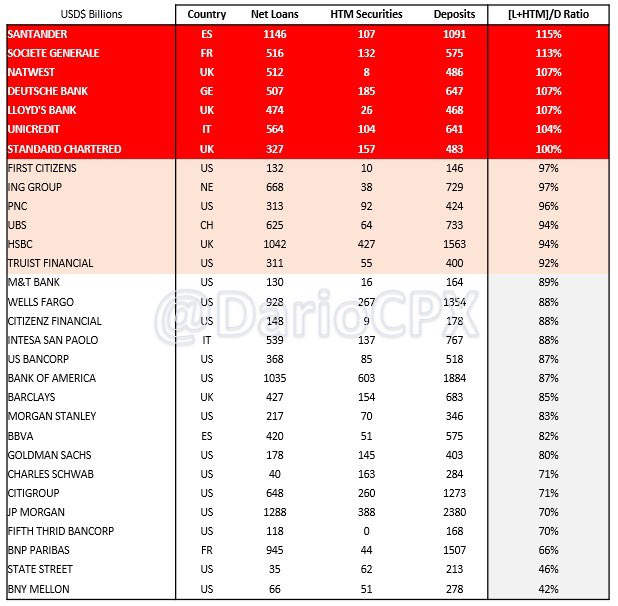
 [LOAN + HTM] / DEPOSIT RATIO HTM books are now officially "Hide to maturity" and stuffed with assets trading at a significant loss because of high interest rates (and soon high credit losses too). Not only banks cannot afford to sell those securities, but trading at such a discount to the par value, they even stop being collateral-worthy. Effectively, the risk of those books is now equivalent to the loan ones. Furthermore, bear in mind there is no #BTFP in Europe, while in the US, that only applies to US Treasuries or government-guaranteed securities. 

Now, check how many banks hold more highly illiquid assets than the deposits they collected...(table 2) I feel now the warning bells in your head are already pretty loud   [LOAN + HTM + AFS] / DEPOSIT RATIO AFS securities aren't Marked to Market but booked according to their "fair value." Translated, their real value in the market is lower due to a lack of liquidity. Now, check how many banks cannot cover their deposits if we include the AFS assets in the analysis... (table 3) I bet now those bells in your head turned into a Marilyn Manson concert!  

 At this point, I hope you agree with me that all those capital ratios and risk metrics the regulators use to assess banks' health are completely useless. As a matter of fact, banks that went bust always had "strong capital" according to the regulatory metrics, from #CreditSuisse (recently) to #Lehman in 2008. Fyi, both banks imploded with an "A" rating!   

Alright, now is time for fireworks!  

 In the last table, I present two scenarios on the current state of banks’ books: 

1 - "La La Land" that only assumes 5% losses on loans, 10% on HTM, and 2.5% on AFS books and compares those with the bank's total equity. 

2 - “Soft Landing" that assumes 7.5% losses on loans, 20% on HTM, and 5% on AFS books. I wanted to include a "Realistic" one, but my heart  couldn't bear it, sorry.  Feel free to play with the data and see what happens if you assumes realistic losses.. 

Considering how twisted the reality we are living in is, I used green crayons to mark all those banks that have high chance of being already insolvent in the “ridiculous” scenarios presented.   

Important to bear in mind is this analysis only considers on-balance sheet items to limit its complexity. However, if we bring in off-balance sheet items I strongly doubt banks like $BAC , $UBS and $HSBC will come up so strong as per previous detailed analysis I posted… 

 Beware, during a financial crisis, all the assets, including "cash and equivalents," suffer a haircut while liabilities only get a haircut  after a company files for Chapter 11. This means that the chances for the assets I left out to be able to increase in value during a crash to compensate for the calculated losses are close to zero.